
WriteHive 2026 Online Conference: Practical Tips for Avoiding Ableism in Your Writing
 Now that the videos from the 2026 WriteHive online conference are posted, I’ll be sharing some of those with quick summaries. Today, I’m talking about the “Practical Tips for Avoiding Ableism in Your Writing” presentation from Nicoletta Poungias.
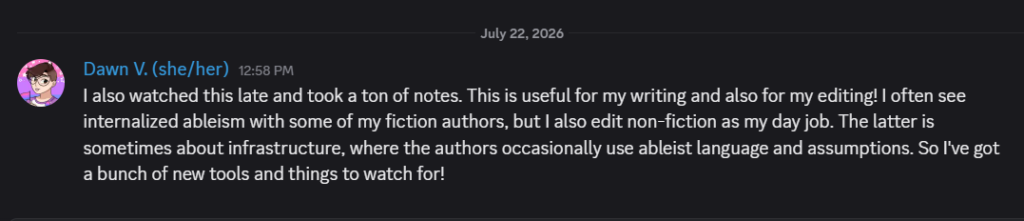
I took a screenshot of my comment on this presentation, which I watched during the WriteHive weekend, but not when it was first shown. My comment says: “I also watched this late and took a ton of notes. This is useful for my writing and also for my editing! I often see internalized ableism with some of my fiction authors, but I also edit non-fiction as my day job. The latter is sometimes about infrastructure, where the authors occasionally use ableist language and assumptions. So I’ve got a bunch of new tools and things to watch for!”
Nicoletta talked about what ableism is, including characters with disabilities in your writing, tropes to be aware of and avoid, and resources for authors. They emphasized the important of having disabled characters in fiction, as the lack thereof, without an explanation, can imply that people with disabilities have been warehoused in special facilities or euthanatized. They also talked about how use of ableist language, even when it’s not directed at a person with disabilities, is still harmful, In particular, using language that insults someone’s body or brain is typically ableist language, and it’s better to focus on a character’s actions or behavior.
Nicoletta also gave a list of things to consider when creating a disabled character, which included:
- Choice of disability (and why)
- Assumptions about the disability
- Symbolism of the disability
- Consequence(s) of the disability
- Accomodations
- World-building
- Socio-economic backround
- Disabled community
They go into all of these in more detail in the presentation, along with offering resources for writing characters with disabilities, emphasizing doing research, talking to disabled people, and working with sensitivity readers. This is a brief presentation, at only 24 minutes, but it’s filled with useful information for authors!

Comments