
Interview with Kit Anderson
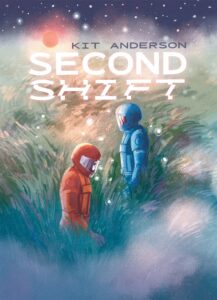 Today, I’m chatting with Kit Anderson, author of the Nebula Award finalist graphic novel Second Shift!
DV: Tell us a little about yourself and your writing.
KA: I’m a cartoonist from Colorado who lives with her partner and elderly dog in a small town outside of Zürich. I keep my writing mostly to comics, but I enjoy prose, too. I tend to stick around in genre, like sci-fi, a bit of fantasy. I have a book of short stories with Avery Hill (Safer Places), and also my latest book, Second Shift, a graphic novel about corporate lackey terraformers in space who have a strange shift at work. It was recently nominated for the Nebula Award in their inaugural comics category, which is very cool. I tell everyone this.
DV: What draws you to writing science fiction?
KA: It’s one of the first genres that drew me in as a kid—my dad introduced me to some of the golden age guys, and they were some of the first grown-up books I remember enjoying. The Alien movies also did something to me early on; I will watch or read any Alien universe thing, no matter how bad. At some point I got into more contemplative sci-fi, like Ursula K. LeGuin, Ray Bradbury, Octavia E. Butler, Jeff Vandermeer, Tarkovsky movies, things like that. As it is with comics, genre can be taken more or less seriously in literary circles (usually less, I’ve found), and for some reason people often seem surprised when they find value there. This has always confused me, even when I was going through a snobby phase myself. I like to point folks who claim genre is trivial (I have met them) to books like Slaughterhouse-Five and Beloved; these books are literary giants, and I’d argue they sit pretty comfortably in genre. So anyway, I’m a fan—it’s a place I’ve always hung out in, and I think a lot of us want to write what we like to take in. Beyond that, it’s fun and exciting to speculate—to magnify an observation far out into the future and wonder how it might all play out. There’s no pressure to be right or anything, just to imagine. While everything is highly influenced by other things (e.g., my corporation in Second Shift, Terracorp, is probably influenced by Weyland-Yutani, but no doubt both were inspired by observations of corporate culture and greed), and while there are existing genre trappings and conventions to play around in, there’s so much about genre that just feels like pure invention. And then, with a comic, the only limit (beyond my imaginative capabilities) is what I can feasibly translate onto the page. When I can balance an interesting concept with real feelings, observations, and experiences, and then balance the cartooning, too, that feels pretty great.
DV: How do you decide if a story you want to tell is better for a short comic or a graphic novel? Have you ever started with one and realized it should be the other?
KA: I can usually find a short story in a big idea, but a small idea can always get bigger, too. That said, ideas seem to come in many sizes. Sometimes it’s just a moment I want to dip into, or a character study, or a situation. Sometimes the world keeps growing. In the case of Second Shift, it started as a short story (“Lookout Station” in Safer Places), but I kept thinking about it, and knew there was a lot more there I wanted to explore. As a short story, I think it functions differently; it’s more situational, less character-driven. It’s a quick visit into that world, and maybe it gives a sense of its own context, but very little of that is actually on the page. In the book, I could fill that in and explore themes, characters, the corporate culture, etc. significantly more. The longer format offers a lot, like a chance to consider an idea deeply, and live with it for a while.
Still, I love the economy of short stories. Comics are cool, too, because—at least for me—they contain this built-in mechanism to refine my ideas and be intentional. I should really need or want that scene/page/panel/image/speech bubble if I’m going to spend all that time drawing and lettering it—it encourages some frugality. In comics, there’s this inherent push and pull between lots of effort vs. simply leaving things unsaid, and I might struggle with that more if I weren’t drawing it, too. I’m scripting a comic right now—it’s a short story, but it keeps growing, and I wince a little every time I add a new scene (at least another week of work). This calculation plays a part when deciding how long something is going to be. Like, “Can I satisfy/serve the idea well in a smaller number of pages?” (short story), or “Will this idea hold my interest? Is it big and exciting enough to spend a few years on?” (graphic novel). The interest part, especially. If I’m not engaged throughout making the comic, I think it’s asking a lot for the reader to be.
DV: What is your favorite thing about writing for graphic novels?
KA: At least until this point, I’ve written and drawn all my comics/graphic novels, and I feel like those are two different people sometimes. One version of Kit writes lazy things like “they go down a strange hallway” and then a later Kit is annoyed later when she has to figure out what that looks like. The writing part often feels free and full of possibility, but when it’s time to draw I have to face the tension between imagination and capability, which is nice and affirming sometimes, frustrating others. It’s good work, I love it, but no part is really easy for me.
I think comics have a lot that’s special about them. I love how many levels they can work on, and how many ways they might be succeeding or failing at any given time. To me, the most central part is the transmission and connection (or failure to connect). How many things I have to do correctly for my signal to get through is exciting. I have to fill-out the world, get the dialogue right, draw clearly, balance page turns and pacing. So much, and it all feels connected, very active when it’s right. My favorite, favorite part is the way that comics don’t feel like comics to me until every part is done—the inks, the lettering, the finish. Before that point, it just doesn’t totally work. I mean, you know if it’s working on some level, but still you’re not sure; you have to stay in that ambiguity until you’re finished. One day you’re looking at a sequence going “Man, I don’t know,” and the next, with the art and lettering in, it just works. That part always feels like magic to me.
DV: What’s next for you in the writing world?
KA: I’m pitching a few things at the moment, but mostly I’ve been working on some short stories in comics and prose. I have one big graphic novel idea in the back of my mind that I keep checking in on—I think it’ll happen but I don’t have exact details at this point. I describe it as a “ranch gothic,” and I hope to start on it in earnest soon. I love making short stories, though, so it’s been nice doing that again for a bit.
DV: Where can folks find you online?
KA: My website is kitkanderson.com, and I’m @igotkittypryde in the usual places.
Thanks for dropping by, Kit! Be sure to check out Second Shift and vote for it in the Nebula Awards this year! Voting closes April 15, 2026.

Comments